Vapor Vacuum

CONTROLLED ABSENCE AS INDUSTRIAL SUBSTRATE

VAPOR VACUUM

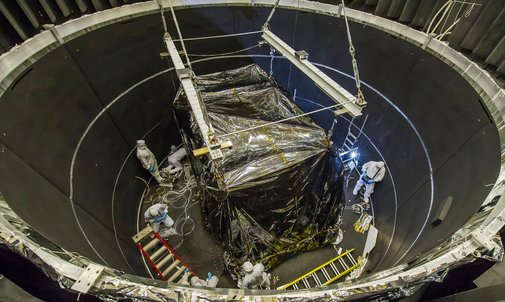
Vapor Vacuum engineers the controlled-absence substrate: low-pressure environments, outgassing-controlled volumes, vapor-transport pathways, deposition spaces, drying chambers, phase-boundary chambers, and ultra-clean process envelopes. Vacuum is not emptiness. It is an engineered operating medium with a specification — pressure, outgassing rate, contamination count, pump-down time — that the rest of the machine stack consumes. Fusion reactors, quantum-computing dilution refrigerators, particle accelerators, and semiconductor fabs all need the same thing: a space in which individual gas molecules become the engineering problem. Vapor Vacuum supplies that space, with documented specs, at industrial scale.

The discipline is industrial-vacuum engineering — mature technology, well-characterised physics, commercial pump and gauge components, and a long lineage of UHV chamber design from the semiconductor and accelerator industries. The product line is a three-tier chamber family (Flex-Chamber, Getter-Vault, Anomaly) paired with a three-volume scaling family (Monolith, Hive, Leviathan). The service layer ships under documented service-level agreements: pump-down time, base pressure, leak budget, bake-out schedule, RGA-receipt verification, and outgassing-rate audit.

Vapor Vacuum — Controlled Absence as Industrial Substrate

We build the controlled absence that the rest of the machine stack consumes. Vacuum is a specification, not a void.

01 — The Discipline

Vacuum is engineered absence. Pressure becomes an industrial variable in the same way temperature, voltage, and frequency are industrial variables: a continuous parameter with documented operating points and tolerances. The atmosphere at sea level sits at roughly 105 Pascals; the moon's surface sits at approximately 10-9 Pa; the residual gas inside a semiconductor deposition chamber during process sits at roughly 10-6 Pa; the highest-grade research chambers run below 10-10 Pa. Across those fourteen decades of pressure, completely different physics governs particle behaviour: at one atmosphere, molecules collide every microsecond and behave like a fluid; at 10-7 Pa, the mean free path is hundreds of metres and molecules behave like an effectively-collisionless gas. The vacuum substrate is the engineered transition between those regimes.1

Vapor Vacuum supplies vacuum envelopes to four primary process categories. Phase-change processes — evaporation, condensation, sublimation, freeze-drying — all rely on low-pressure environments to shift phase boundaries to convenient temperatures. Plasma processes — sputtering, etching, ion implantation, plasma deposition — require a controlled low-pressure neutral background in which an electrical discharge can sustain stable plasma chemistry. Deposition processes — thermal evaporation, electron-beam evaporation, chemical vapor deposition, atomic layer deposition — require contamination-free surfaces and long mean free paths so deposited atoms reach the substrate without scattering. Thermal-control processes — cryogenic insulation, space-environment simulation, vacuum-jacketed transport lines — use vacuum as a near-perfect thermal insulator by suppressing convective heat transfer.2

The discipline treats vacuum as a service spec, not as an idealised infinity. A real industrial vacuum chamber has a documented base pressure (the lowest pressure achievable with all pumps running and no process gas flowing), an outgassing rate (mass-per-area-per-time of residual gas released from the chamber walls and components), a leak budget (mass-per-time of atmospheric air admitted through imperfect seals), and a pump-down profile (the pressure-versus-time curve from atmospheric to operating point). Every component in the chamber — seals, feedthroughs, viewports, gauges, motion stages — carries its own outgassing and leak contribution that must integrate into the chamber-level budget.

02 — The Bottleneck

Conventional machines assume air. Air is the implicit working fluid for almost every product designed without explicit vacuum consideration: it carries heat, it bears load on bearings, it equalises pressure across moving boundaries, it provides a return path for static charge, it dilutes contaminants. Stripping air away removes every one of those mechanisms simultaneously. The bottleneck is not vacuum itself; it is the engineering work required to replace, around, or live without each of those air-mediated behaviours.3

Outgassing. Every material in a vacuum chamber slowly releases adsorbed gas: water trapped in metal oxide layers, hydrocarbons from machining fluids, dissolved gases from polymer seals, hydrogen permeating from steel grain boundaries. At 10-7 Pa, the outgassing rate of an unbaked stainless-steel chamber typically swamps the pumping speed; the chamber simply cannot reach lower pressure until the wall load is reduced through bake-out, glow-discharge cleaning, or specialised low-outgassing materials.

Leaks. Real seals leak. O-rings leak slowly at room temperature, faster at temperature extremes, and catastrophically when contaminated or damaged. Metal-gasket seals (CF flanges) leak more slowly but are less forgiving. The leak budget is a chamber-level integration across every seal, feedthrough, and weld; helium-leak-detection metrology is required at every assembly stage to maintain the budget.

Pump-down time. Pumping a large chamber from atmosphere to UHV takes hours to days, dominated by water vapor desorption from the walls. Industrial-throughput applications cannot tolerate that cycle time directly; the engineering response is multi-chamber airlock architecture, where the process chamber stays under vacuum and parts cycle through smaller load-locks.

Condensation and vapor transport. Cold spots inside a chamber collect condensable vapor and become persistent contamination sources. Thermal-gradient management, cryotrap design, and getter-pump placement are the engineering tools.

Particulate contamination. Pumping cycles, gas flows, and moving stages all generate particles. Particle counts directly limit semiconductor yields and bias optical-instrument performance. Particulate engineering — oil-free pump selection, laminar flow management, surface electropolishing — is half of practical UHV work.

Thermal load. Vacuum is a near-perfect thermal insulator, which is desirable for cryogenic-jacket applications and inconvenient for process chambers where heat must be extracted. Thermal management inside vacuum requires conducted-path cooling, radiative coupling to cold reservoirs, or process-gas thermal coupling at controlled pressures.

03 — The Vacuum Envelope

The vacuum envelope is the engineered boundary between the process volume and the outside world. Its components are individually mature; the engineering work is integration and budget management:4

Chamber bodies. 304L or 316L electropolished stainless steel for general-purpose UHV; aluminum for lower-cost high-vacuum; titanium for hydrogen-sensitive applications; copper-jacketed for cryogenic compatibility. Wall thickness is sized to external-pressure-collapse load with a safety factor; chamber geometry is sized to mean-free-path requirements and pump-throat conductance.

Pumps. Roughing pumps (oil-free scroll or dry-screw) take atmosphere down to roughly 1 Pa; turbo-molecular pumps span 1 Pa to 10-7 Pa with high pumping speed; ion pumps and titanium-sublimation pumps cover 10-7 Pa to UHV with no moving parts and no vibration; cryopumps trap condensable gases at the cold-head surface for high-throughput high-vacuum service.

Seals. Elastomer O-rings (Viton, Kalrez) for serviceable joints up to high vacuum; metal-gasket CF flanges (copper or aluminum gaskets) for UHV-grade joints; explosion-bonded or e-beam-welded permanent seams where serviceability is unnecessary; ConFlat-style knife-edge geometry for repeatable bake-out service.

Feedthroughs and viewports. Electrical feedthroughs (ceramic-to-metal brazed); optical viewports (sapphire or fused silica with engineered seal geometry); motion feedthroughs (magnetic-coupled or bellows-sealed); gas-injection feedthroughs (controlled-flow capillary or mass-flow controller).

Gauges and diagnostics. Capacitance manometers (atmospheric to medium-vacuum); Pirani / thermocouple gauges (roughing range); cold-cathode and hot-filament ionisation gauges (high-vacuum and UHV); residual-gas analysers (mass-spec quadrupoles for species identification and outgassing fingerprinting).

The Vapor Vacuum platform integrates these mature components into chamber families with documented specifications. The engineering claim is not invention of new vacuum physics; it is industrialisation of vacuum-chamber design as a reproducible product rather than a per-customer custom build.

04 — Vapor, Phase, and Surface Processes

Beyond the bare chamber, half of the engineering value sits in process-specific subsystems that ride on the vacuum envelope. These connect directly to sister-division process needs:5

Vapor deposition. Thermal-evaporation sources, electron-beam evaporators, sputter targets, and CVD/ALD precursor delivery systems all sit inside the vacuum envelope. The platform supplies pre-integrated source mounts, water-cooled crucibles, and process-gas distribution rings as chamber sub-assemblies. Phase Flash atomic-printing integration is the flagship deposition-pathway product, with the chamber engineered for sub-nanometre deposition rate control.

Plasma-compatible chambers. Plasma Press femtosecond-ablation processes and Maxwell Continuum plasma-simulation test rigs both require chambers with low-recombination wall materials, RF feedthroughs at controlled impedance, and Langmuir-probe access ports. The platform's plasma-class chambers include these as standard rather than per-project options.

Freeze-drying and lyophilisation chambers. Matter Kitchen freeze-drying processes and Cellular Foundry tissue-handling research use controlled-vacuum chambers with cold-shelf temperature programs. The platform's lyophilisation-class chambers integrate refrigerated shelves with vacuum-side pressure control.

Vacuum thermal insulation. Cryogenic transport lines, dewar jackets, and Modular Habitats hermetic-pressure envelopes use vacuum as the thermal-insulation layer between an inner cold volume and the outer environment. The platform supplies vacuum-jacketed transfer-line components and habitat-scale insulation panels.

Phase-boundary research. Stellar Furnace pulse-target chambers and Antimatter trap UHV volumes both push toward the platform's highest-grade Anomaly tier. Phase-boundary research at extreme low pressure is the most engineering-discipline-intensive application; component selection, weld qualification, bake-out protocol, and contamination control all integrate into a single chamber-level acceptance test.6

05 — Process Classes

The platform's product lines map onto six process classes, each with a documented pressure range, scale, and acceptance specification:

FLEX-CHAMBER  //  ROUGH-VACUUM INDUSTRIAL DRYING102 – 10-1 Pa  //  Monolith to Leviathan volume  //  lyophilisation, vapor degreasing, low-vacuum thermal cycling
GETTER-VAULT  //  HIGH-VACUUM DEPOSITION10-3 – 10-6 Pa  //  Monolith to Hive volume  //  PVD, CVD, electron-beam evaporation, sputter coating
ANOMALY  //  ULTRA-HIGH-VACUUM RESEARCH10-7 – 10-10 Pa  //  Monolith volume only  //  surface science, accelerator beamlines, antimatter trap precursor chambers
VAPOR-TRANSPORT LINE10-3 – 10-5 Pa  //  modular distribution  //  gettered vapor distribution between process chambers
JACKET-CLASS THERMAL INSULATION10-4 – 10-6 Pa  //  transfer-line to habitat volume  //  cryogenic transport, dewar jackets, hermetic habitat envelopes
PLASMA-VACUUM HYBRID10-1 – 10-4 Pa  //  Monolith to Hive volume  //  plasma-deposition, plasma-etch, RF-discharge process chambers
FLEX-CHAMBER / GETTER-VAULT / ANOMALY — volume scaling: MONOLITH (single chamber) / HIVE (modular bay) / LEVIATHAN (10,000+ m3)

Each class ships under a documented service-level agreement covering base pressure, leak rate, outgassing rate, pump-down time, and contamination spec. Acceptance testing follows the Metric Infrastructure measurement grammar so process specs are comparable across deployments.

06 — Division Integration

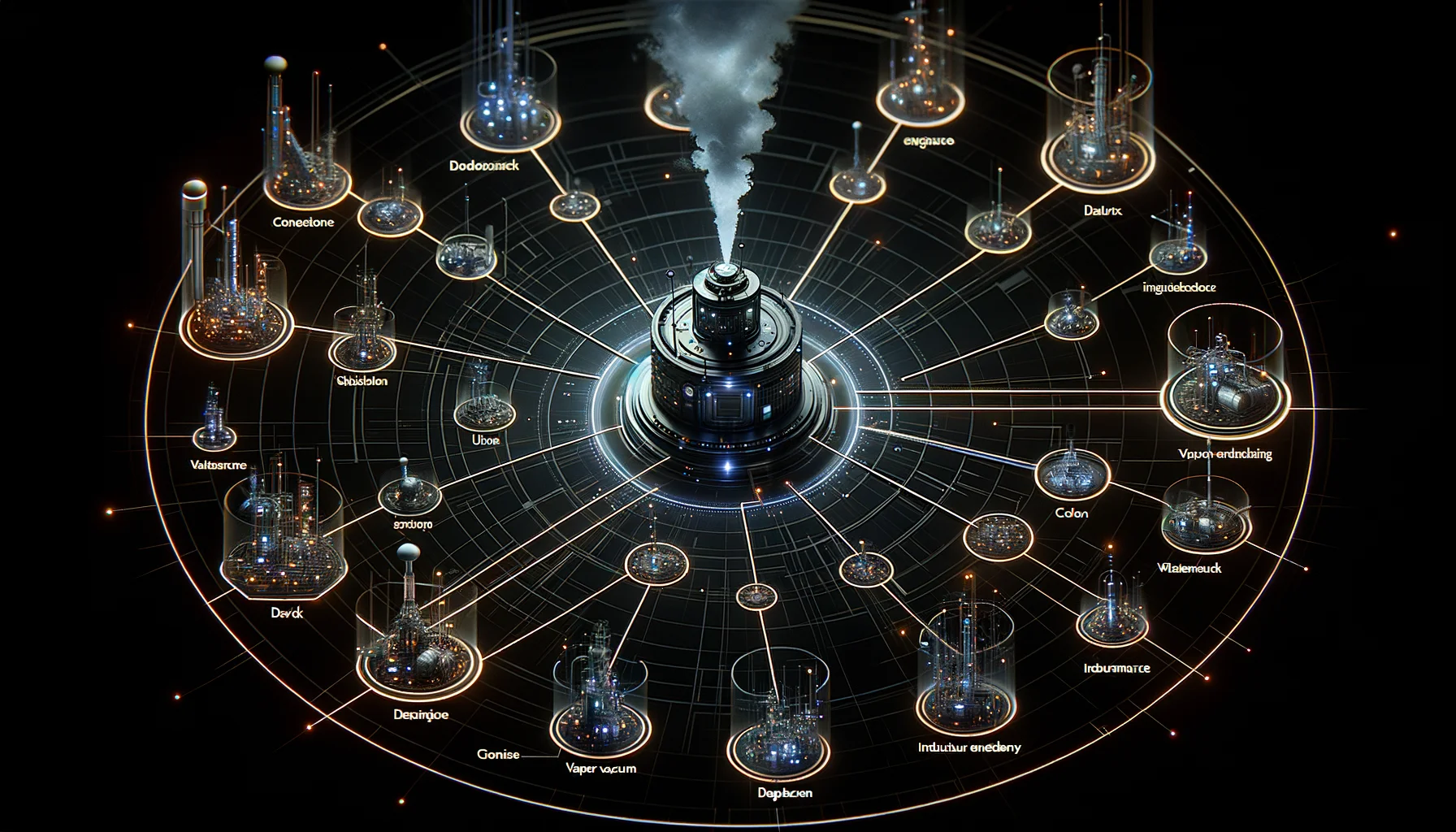
Vapor Vacuum is the most cross-cutting substrate in the network. Eight division platforms consume vacuum infrastructure as a precondition for their primary process:

Phase Flash — Atomic-printing chambers integrate pressure-collapse and water-phase systems with vapor deposition. Vapor Vacuum supplies the chamber, pump skid, gas-distribution ring, and deposition source mounts.

Plasma Press — Femtosecond-ablation page-writing operates in plasma-compatible high vacuum. Vapor Vacuum supplies plasma-class chambers with RF feedthroughs and low-recombination wall coatings.

Antimatter — Trap precursor chambers operate at the Anomaly tier (sub-10-10 Pa). Vapor Vacuum supplies the chamber, bake-out tooling, and instrumentation suite. Trap-grade UHV remains an engineering target rather than a routine commercial product.7

Metallic Sciences — Vacuum-rated chambers, seals, and high-temperature wall structures co-developed under shared metallurgy. Triazite W-Re-HfC alloy components for extreme bake-out and high-flux applications.

Polymer Press — Outgassing-compatible polymer seals (Polymer-V family) and membrane panels for serviceable chamber joints. Polymer outgassing rates characterised under platform acceptance protocols.

Matter Kitchen — Freeze-drying and vacuum-assisted food processes use Flex-Chamber rough-vacuum and Jacket-Class thermal-insulation product lines.

Stellar Furnace — Pulse-target chambers and high-energy diagnostic vacuum integrate Getter-Vault and Anomaly tiers. Plasma-class chambers for fusion-relevant target studies.

Lorentz Aerospace — Plasma-test chambers and high-altitude / hypersonic environmental-simulation chambers. Vacuum + thermal-load coupling for re-entry-relevant materials testing.

Phase Flash → Plasma Press → Antimatter → Metallic Sciences → Polymer Press → Matter Kitchen → Stellar Furnace → Lorentz Aerospace →

07 — Validation Hooks

Five measurable hooks define the forward roadmap. Each is a chamber-level performance metric; none requires new vacuum physics, all require engineering discipline.

HOOK A — pump-down time at scale. Current Hive-volume Getter-Vault chambers take approximately 4 hours from atmosphere to 10-6 Pa. Forward target: 1 hour, achieved through pre-bake interior coatings, distributed turbopump architecture, and water-vapor-specific cryotrap arrays. Demonstration is a documented Hive-volume chamber reaching 10-6 Pa within 60 minutes from atmosphere with full instrumentation suite active.8

HOOK B — leak rate audit reproducibility. Current platform-level leak budgets are validated at acceptance, but field-drift audits show approximately 15 percent variance between specification and 6-month-deployed measurement. Forward target: less than 5 percent variance through standardised re-audit protocols and instrumented gasket-replacement service cycles.

HOOK C — outgassing rate of unbaked chamber. Current 316L-stainless chambers deliver approximately 10-8 Pa-litre per second per square centimetre at room temperature after standard cleaning. Forward target: 10-9 Pa-litre per second per square centimetre through low-hydrogen-content steel grades, in-line electropolish, and vacuum-fire pre-treatment protocols.

HOOK D — vapor capture efficiency. Current vapor-deposition source-to-substrate transfer efficiency varies from 30 to 70 percent depending on geometry. Forward target: documented 80 percent transfer efficiency in Phase-Flash-class chambers through engineered source geometry and substrate-temperature programs.9

HOOK E — energy per pressure decade. Current platform energy budget (electrical input per chamber per pump-down cycle, normalised to log-pressure-decade) sits at approximately 2 kWh per chamber per decade. Forward target: 0.5 kWh per decade through pump-staging optimisation and heat-recovery from compression cycles. Pure efficiency engineering; no new physics required.

RESEARCH REPOSITORY

Vacuum engineering, UHV materials, vapor deposition, phase-change systems, plasma chambers, leak detection and metrology.

Vapor Vacuum is the controlled-absence substrate. The discipline is industrial vacuum engineering — mature components, integrated chamber design, documented service specifications. Three chamber tiers (Flex-Chamber / Getter-Vault / Anomaly) scale across three volume classes (Monolith / Hive / Leviathan). Eight sister divisions consume vacuum as substrate. The forward roadmap is engineering discipline applied to pump-down time, leak rate audit, outgassing control, vapor capture efficiency, and energy per pressure decade.

Reference Links — Vacuum Engineering

(wiki) Vacuum  •  (wiki) Ultra-High Vacuum  •  (wiki) Vacuum Pump  •  (wiki) Pressure Measurement

Reference Links — UHV Materials & Outgassing

(wiki) Outgassing  •  (wiki) Bakeout  •  (wiki) ConFlat Flange  •  (wiki) Getter Pump

Reference Links — Vapor Deposition & Phase Processes

(wiki) PVD  •  (wiki) CVD  •  (wiki) ALD  •  (wiki) Lyophilisation

Reference Links — Plasma Chambers & Leak Detection

(wiki) Sputter Deposition  •  (wiki) Plasma Processing  •  (wiki) Helium Leak Detection  •  (wiki) Residual Gas Analyser

Bibliography
  1. O'Hanlon, J.F. A User's Guide to Vacuum Technology. 3rd Ed. Wiley, 2003. ISBN 978-0-471-27052-2.
  2. Chambers, A. Modern Vacuum Physics. Chapman & Hall / CRC, 2004. ISBN 978-0-849-32438-4.
  3. Roth, A. Vacuum Technology. 3rd Ed. North-Holland, 1990. ISBN 978-0-444-88010-9.
  4. Smith, D.L. Thin-Film Deposition: Principles and Practice. McGraw-Hill, 1995. ISBN 978-0-070-58502-3.
  5. Lieberman, M.A. & Lichtenberg, A.J. Principles of Plasma Discharges and Materials Processing. Wiley, 2005. ISBN 978-0-471-72001-0.
Endnotes
  1. Pressure regime physics: well-established. Mean-free-path at 10-7 Pa  ≈  hundreds of metres — collisionless-gas regime is the standard textbook treatment.
  2. Four process categories: program structure. Each category corresponds to mature commercial subsystems; integration into chamber-level products is the engineering work.
  3. Bottleneck taxonomy: standard vacuum-technology curriculum (O'Hanlon, Chambers, Roth). Outgassing dominance at UHV is the operationally-significant bottleneck.
  4. Envelope components: each individually mature commercial technology. The platform's claim is industrialisation of the integration, not invention of components.
  5. Process-specific subsystems: engineering integration program. Each subsystem maps to a sister-division process flow.
  6. Phase-boundary research at the Anomaly tier: engineering target. Antimatter trap precursor chambers represent the platform's most extreme baseline; routine commercial Anomaly-tier service is an aspirational goal.
  7. Antimatter trap UHV: engineering integration target. Sub-10-10 Pa is achievable in research chambers; productisation as a routine commercial Anomaly-tier offering is forward work.
  8. Hive-volume 60-minute pump-down: engineering target. Pre-bake coatings + distributed turbopump + cryotrap arrays are individually known; integration into a routine product cycle is the demonstration.
  9. 80 percent vapor-deposition transfer efficiency: engineering target. Geometric-source optimisation is a long-standing process-engineering activity; documented 80 percent in production is the forward goal.