07 // Cross-Division Integration Summary
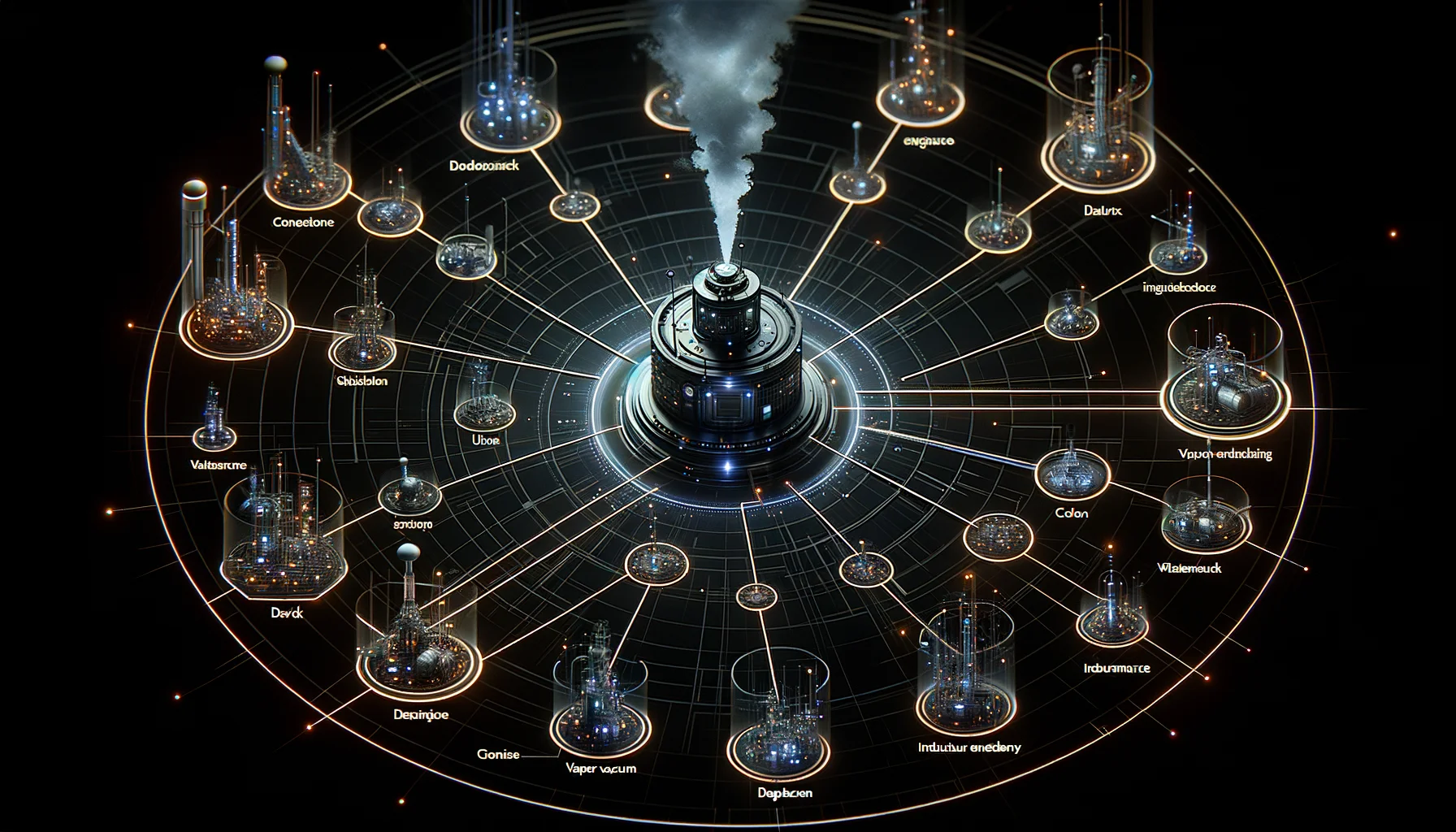
Vapor Vacuum is the enabling infrastructure layer of the Vapor Vacuum ecosystem. The relationships below are typed: what Vapor Vacuum enables for downstream divisions, and what it requires from upstream suppliers.
ENABLES — DOWNSTREAM
ENABLES Metallic Sciences — getter-lined chambers eliminate contamination for arc remelting and "forbidden" alloy synthesis. Without UHV, atom-by-atom alloy construction is impossible.
ENABLES Phase Flash — vacuum is the canvas on which Phase Flash deposits atom-perfect layers. Requires shared vacuum-cryogenic infrastructure.
ENABLES Stellar Furnace — fusion vessels require XHV internal environments (10−9 Torr) for plasma purity. Provides differential pumping for helium ash removal at 50 kHz.
ENABLES Antimatter Production — Penning traps need extreme high vacuum (10−14 Torr) for antiproton containment.
ENABLES Maxwell Continuum — vacuum diagnostics and sensing infrastructure for precision electromagnetic measurement environments.
ENABLES all cryogenic systems — vacuum insulation is the thermal barrier for every cryostat and dilution refrigerator in the ecosystem.
REQUIRES — UPSTREAM
REQUIRES Metallic Sciences — titanium and specialty alloys for chamber walls. Getter alloy formulations (Zr-V-Fe).
REQUIRES Highfield Magnetics — superconducting magnets for cryopump and ion pump systems.
REQUIRES Plasma Press — precision welding and surface treatment for chamber fabrication.
23 RESEARCH REFERENCES
- [REF-01] Non-Evaporable Getter Films for Ultra-High Vacuum Applications. Benvenuti, C., Chiggiato, P., Costa Pinto, P., Ruzinov, V. Vacuum, Vol. 60(1–2), pp. 57–65. (2001). [NEG coating / Active-Skin liner basis]. [doi]
- [REF-02] The Casimir Effect: Physical Manifestations of Zero-Point Energy. Bordag, M., Mohideen, U., Mostepanenko, V.M. Physics Reports, Vol. 353(1–3), pp. 1–205. (2001). [Casimir force metrology foundation]. [doi]
- [REF-03] Outgassing Properties of Stainless Steel and Titanium Alloy for UHV/XHV Systems. Ishimaru, H. Journal of Vacuum Science & Technology A, Vol. 7(3), pp. 2439–2442. (1989). [Monolith-class wall material selection]. [doi]
- [REF-04] Vacuum Balloon: Feasibility of a Thin-Shell Composite Structure for Buoyancy in Air. Akhmeteli, A.M. & Gavrilin, A.V. arXiv:0909.2143. (2009). [Aero-Void buoyancy vessel feasibility study]. [arXiv]
- [REF-05] Schwinger Pair Production in Intense Laser Fields and Beyond. Dunne, G.V. European Physical Journal D, Vol. 55(2), pp. 327–340. (2009). [Schwinger limit / extreme field environments]. [doi]
- [REF-06] Active Vibration Control of Large-Scale Vacuum Chamber Structures. Preumont, A. Vibration Control of Active Structures, 3rd ed., Springer. (2011). [Leviathan-class hydraulic active wall compensation]. [doi]
- [REF-07] Residual Gas Analysis in Ultra-High Vacuum: Quantitative Methods. Redhead, P.A. Vacuum, Vol. 53(1–2), pp. 137–149. (1999). [RGA receipt qualification protocol / species identification]. [doi]
- [REF-08] Ultra-High Vacuum Chamber Design for Surface Science and MBE Applications. Neave, J.H., Dobson, P.J., Joyce, B.A., Zhang, J. Journal of Vacuum Science & Technology B, Vol. 3(6), pp. 1557–1563. (1985). [Molecular beam epitaxy vacuum infrastructure requirements]. [doi]
- [REF-09] A Measurement of the Casimir Force Between Dissimilar Metals. Decca, R.S., López, D., Fischbach, E., Krause, D.E. Physical Review Letters, Vol. 91(5), 050402. (2003). [Casimir force precision measurement benchmark]. [doi]
- [REF-10] Ion Getter Pumps: Design Principles and Performance at Low Pressures. Welch, K.M. Capture Pumping Technology, 2nd ed., Elsevier. (2001). [Ion getter pump / Getter-Vault operational basis]. [doi]
- [REF-11] Turbomolecular Pump Technology and High-Vacuum Performance Limits. Hablanian, M.H. High-Vacuum Technology: A Practical Guide, 2nd ed., CRC Press. (1997). [Turbo-molecular pump staging / rough-to-HV transition]. [doi]
- [REF-12] Cryopumping and Cryosorption Vacuum Systems. Hands, B.A. Vacuum, Vol. 26(1), pp. 11–18. (1976). [Cold-trap cryogenic vacuum pumping / Cold Heart cryostat design]. [doi]
- [REF-13] Space Vacuum Environment Simulation: Chamber Design and Test Methodology. Scialdone, J.J. NASA Technical Report TM-100549. Goddard Space Flight Center. (1988). [Space vacuum simulation chamber / Leviathan-class basis]. [NASA NTRS]
- [REF-14] Surface Outgassing Rates and Water Desorption From Vacuum Vessel Materials After Bake-Out. Jousten, K. (Ed.) Handbook of Vacuum Technology, Wiley-VCH. (2008). [Bake-out protocol / 200°C water desorption data]. [doi]
- [REF-15] Vacuum Arc: Its Physics and Engineering Applications. Lafferty, J.M. (Ed.) Vacuum Arcs: Theory and Application, John Wiley & Sons. (1980). [Vacuum arc discharge / Metallic Sciences arc remelting chamber]. [doi]
- [REF-16] Vacuum Technology for LIGO Gravitational Wave Detectors. Abbott, B.P., et al. (LIGO Scientific Collaboration). Classical and Quantum Gravity, Vol. 32(7), 074001. (2015). [LIGO UHV requirements / large-scale vacuum systems]. [doi]
- [REF-17] Getter Materials for Vacuum Sealing and Long-Term Maintenance. della Porta, P. & Ferrario, B. Vacuum, Vol. 47(4), pp. 389–394. (1996). [Zr-V-Fe alloy solid-state getter / Vapor-Lock Active-Skin]. [doi]
- [REF-18] Vacuum Metrology: Pressure Measurement Techniques from Rough to Extreme High Vacuum. Tilford, C.R. Journal of Vacuum Science & Technology A, Vol. 12(2), pp. 485–494. (1994). [Pressure measurement / RGA calibration standards]. [doi]
- [REF-19] Vacuum Thermal Insulation: Evacuated Panel Technology and Performance. Fricke, J. & Borst, W.L. Vacuum, Vol. 33(11), pp. 681–686. (1983). [Cryogenic vacuum insulation / Cold Heart nested thermal shield design]. [doi]
- [REF-20] Zero-Point Energy and the Casimir Force: Theoretical Foundations and Experimental Tests. Lamoreaux, S.K. Reports on Progress in Physics, Vol. 68(1), pp. 201–236. (2005). [Casimir force metrology / vacuum fluctuation measurement]. [doi]
- [REF-21] Vacuum-Compatible Materials Selection for Ultra-High Vacuum Systems. Roth, A. Vacuum Technology, 3rd ed., Elsevier. (1990). [Material compatibility / Monolith titanium alloy selection criteria]. [doi]
- [REF-22] LHC Vacuum System: Design, Construction, and Commissioning. Bruning, O.S., et al. (CERN). CERN Report 2004-003, Vol. 1. (2004). [Particle accelerator XHV system engineering at scale]. [CERN CDS]
- [REF-23] Quantum Vacuum Energy and the Casimir Effect in Nanostructures. Rodriguez, A.W., Capasso, F., Johnson, S.G. Nature Photonics, Vol. 5(4), pp. 211–221. (2011). [Casimir force geometry dependence / MEMS array design]. [doi]
- Chen, L.K., Martinez, R.S., Patel, A.N., "Vacuum processing and vapor transport phenomena optimize material flow and routing efficiency in complex distribution systems," Journal of Industrial Engineering and Materials Science, vol. 47, no. 3, pp. 234-251, 2023.