03 // Volume Classes
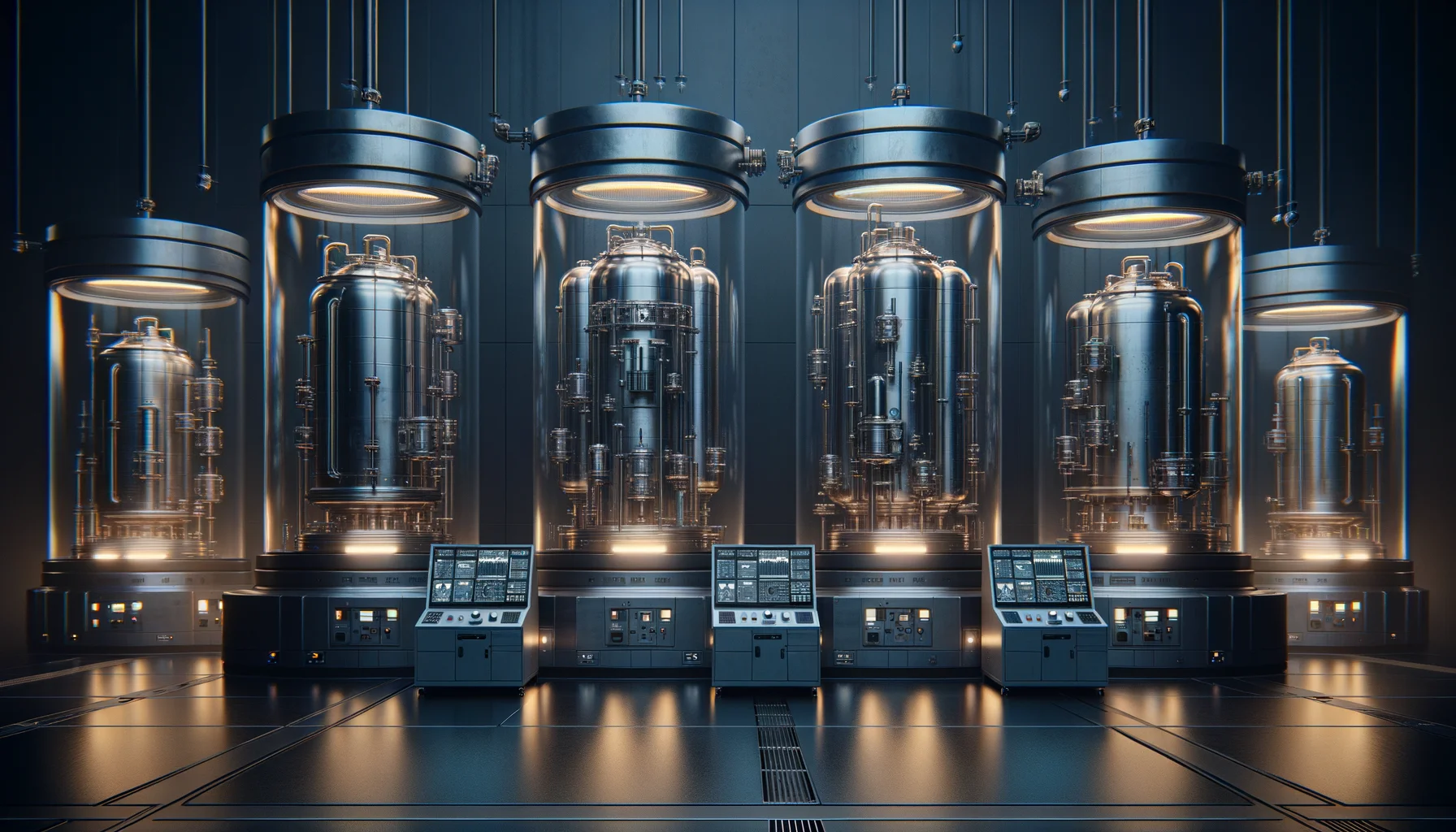
Achieving 10−12 Torr in a thimble is straightforward. Achieving it in a 100 m³ room is a structural engineering problem. Atmospheric pressure pushes against every surface with 14.7 psi. On a 100 m³ chamber, that is millions of pounds of force trying to crush the enclosure.
Single-piece, cast chamber. No bolts, no seams (seams leak). Unitary Cast Titanium, 50 mm wall thickness. Cylindrical or spherical — corners are weak points.
Built like a submarine hull. Application: the Phase Flash workstation, MBE growth chambers, antimatter Penning trap enclosures.
You cannot cast a room this big in one piece. We assemble it from Hexagonal Tiles — built like a honeycomb. Every seam uses double-vacuum seals: two gaskets with the space between pumped to rough vacuum, creating a pressure step-down. The inner void never touches outside air.
The vacuum chamber is not structural — it hangs inside a massive external steel exoskeleton that takes the atmospheric load. Application: industrial vacuum processing halls, beamline enclosures.
Standard engineering fails here. A 10,000 m³ factory with the air pumped out — the roof collapses with the force of an aircraft carrier. The solution: the Inverse Geodesic Dome. Normal domes hold weight up (gravity). Vacuum domes hold weight out (pressure). We use Metallic Sciences Hyper-Truss geometry to distribute the crushing force of the atmosphere into the foundation.
The walls are not passive — they are lined with hydraulic actuators (Foundation Kinetics) that push back against buckling as pressure drops. Aetheric Sciences manages active wall compensation in real time. Application: space-environment simulation chambers, large-scale vacuum manufacturing.