10 // Large-Scale Chamber Concepts
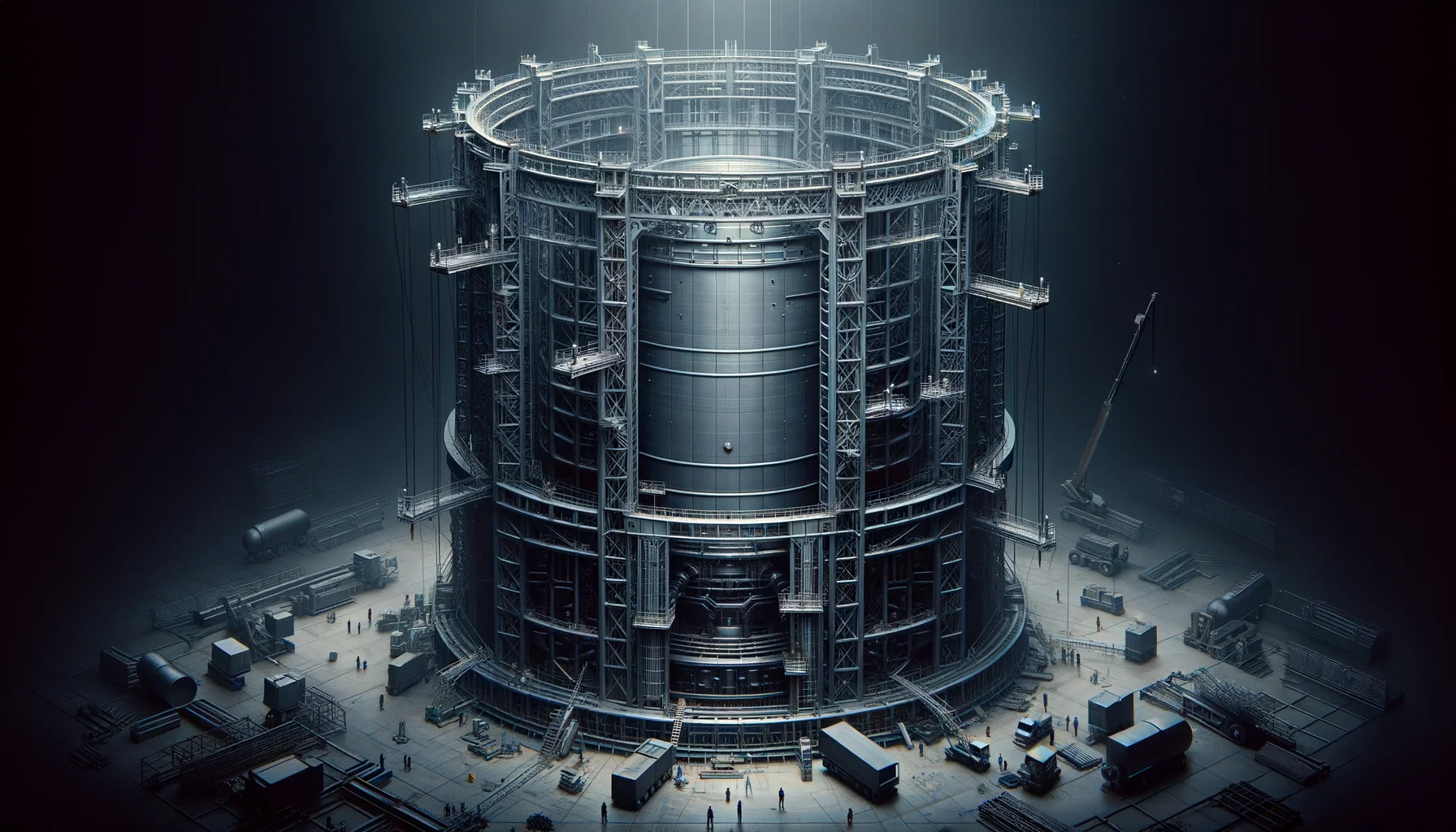
Beyond the Leviathan class (1,000–10,000 m³), scaling vacuum enclosures introduces structural challenges that have no precedent in existing vacuum engineering. Atmospheric pressure exerts 101 kN per square meter on the vessel wall. A 10,000 m³ sphere must resist a total inward force exceeding 200 MN while maintaining leak rates below 10−9 mbar·L/s across weld seams measured in kilometers. These are not catalog products. They are design studies for infrastructure that may take decades to build.
CURRENT — 10–100 m³ modular chambers (Flex-Chamber / Getter-Vault)
NEAR-TERM — 100–1,000 m³ industrial exoskeleton chambers (Anomaly class)
PROGRAM-SCALE — 1,000–10,000 m³ custom infrastructure (Leviathan class)
STRATEGIC VISION — > 10,000 m³ space-environment simulation facilities
At the strategic-vision scale (>10,000 m³), the dominant challenges shift from vacuum engineering to civil engineering. A spherical vessel of 30 m radius requires 316 mm stainless steel wall thickness to resist atmospheric collapse at a 4:1 safety factor, producing a shell mass exceeding 25,000 tonnes. Foundation loads reach 250 kN/m², demanding bedrock anchoring or piled foundations. Thermal management becomes a significant concern: the vessel's thermal mass means that a 1°C ambient temperature swing produces differential expansion of 0.4 mm/m across the shell, requiring expansion joints that must also maintain hermetic seal. Seismic qualification at these scales follows nuclear containment methodology. These are credible engineering studies, not aspirational projections — the physics is understood, the cost and timeline are the constraints.